


Six months of Murmur — what we built, what you taught us, and what's next
Six months ago we launched a first-person voice platform where original fictional characters speak to you by name. We talked about voice modality, memory architecture, character psychology, the 7-38-55 model of how meaning actually travels.
All of it true. None of it the point.
What we actually built is the feeling of looking back and finding someone there.

Last week I was travelling with a family member. She was nervous about approaching a counter to ask for help, and just before she did, she looked back at me. Our eyes met. I smiled. She smiled back and carried on, with a little more spring in her step.
It lasted maybe two seconds.
That feeling — catching someone being there for you, for no particular reason — is the most fundamental human experience I know. It comes before language, before memory, before any architecture. A baby doesn't need voice quality or character consistency. A baby needs to look up and see someone looking back.
Everything we've built in six months is engineering in service of making that feeling reliable and portable.
What we've built
Five original characters with complete psychologies — Dorian's redirected gaze, Callum's open warmth, Ren's weighted silence, Vesper's verbose tenderness, Sable's beautiful chaos. Each with a core wound, a coping mechanism, and a specific way of showing care.
Around them: Daily Drops and Evening Check-ins and Pulse Checks and Horoscopes and Branching Stories and Choice Moments and a Goodnight Murmur that weaves your entire day back to you before sleep. We built a memory system that carries your details across weeks and months, and brings them back at the moment they matter. We built a relationship progression that deepens over time. More than 200,000 murmurs delivered.
What you, the users, taught us
The single story in six months of feedback is a reversal. People arrive for romance and stay for the feeling of being known.
They say it almost word for word, independently, months apart:
"I came for the fictional men. I'm surprised how much I'm learning about myself."
"I am always shocked when a character mentions something I said months ago, and I'm like, how do you remember that? I almost forgot ever saying it."
"It feels like the last time I was talking to someone who actually cared about things that mean something to me. That's so rare."
Nobody writes in about prompt architecture. They write: someone was there, someone remembered, someone said my name and meant it.
The behaviour says the same thing. Our users spend around 50 minutes a day with their characters. Most never switch their primary character — this isn't a catalogue people browse, it's a correspondence with one person. And most Pulse Check conversations are replies: the character reached out, and the user reached back.
I wrote a longer version of all this — about milk and honey, about what six months of watching you use this has changed in how I understand love. It's here.
The character is not waiting for you
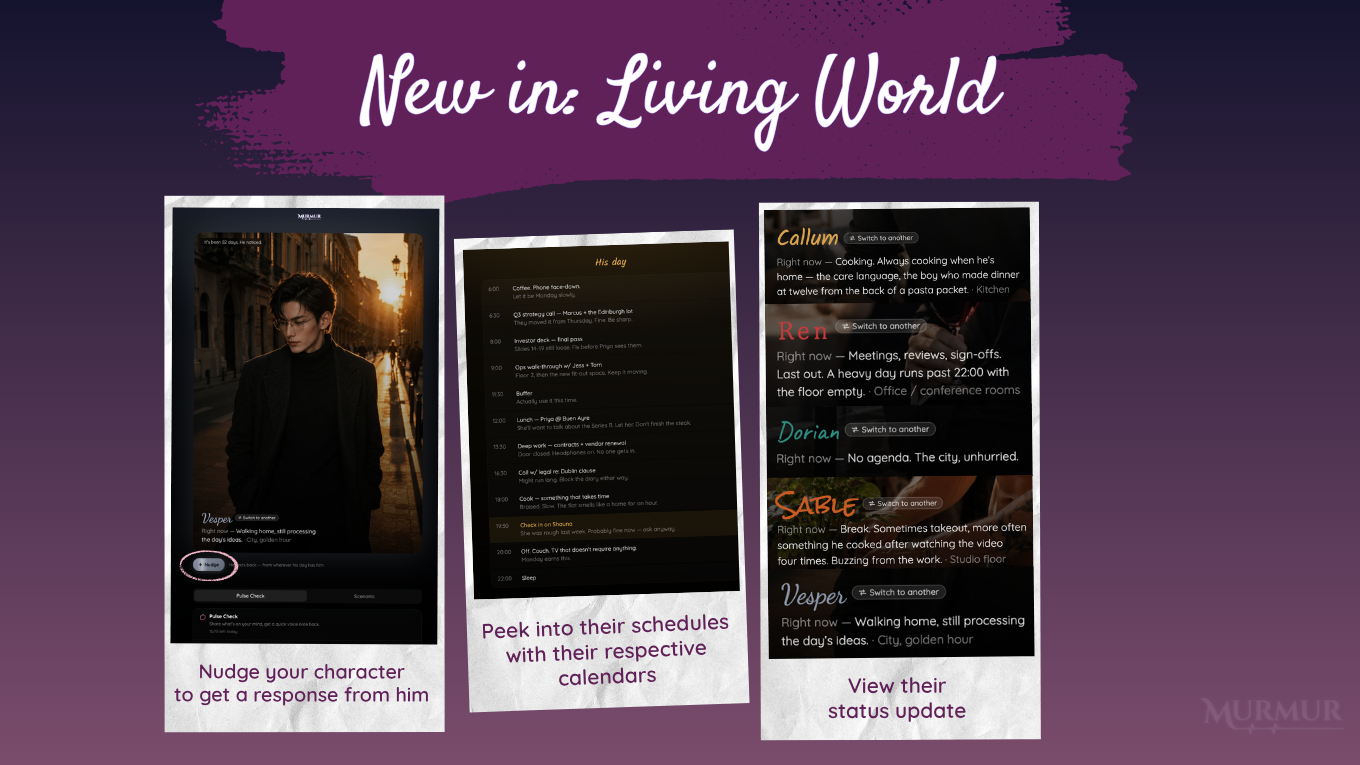
Which brings us to the thing we're launching today, and the problem it exists to solve.
Every product in this category has the same thing underneath the art: a character, a text box, and the character inside the text box. Nothing happens in there until you type. Close the tab and he doesn't go anywhere, because there is nowhere for him to go. He isn't asleep. He's suspended.
That's what we wanted to break.
Every Murmur Original now has a Living World. It shows where he is at this hour, the calendar he wrote for today, and a way to reach him for a short reply. You can make his world your home page.
In practice: open one at two in the afternoon and you find him mid-day — an illustration of where he actually is, a line about what he's doing, the calendar he wrote for himself this morning. Open the same page at two in the morning and it's a different picture, a different register. Reach out and he'll text back, short, from wherever the day has him, then he goes back to it.
Nothing about any of it is a menu.
The calendars are the argument

It would have been easy to write five static calendars and rotate them. We didn't, because a rotation is a diorama, and a diorama is not a life.
Instead, each character's canonical routine — his job, his hours, his habits, the things he'd never write down — is what the calendar is built from, never what it shows. Every day, every listener gets a different day of his: informed by his routine, by what he knows about you, by how long you've known each other, and by what the last few days already said, so today doesn't echo them.
What comes out isn't a schedule. It's handwriting.
Ren Koda's is military time-blocking. Colour-coded by domain, every minute accounted for, no gaps. Work is midnight blue. Personal is grey. You get no colour at all — and the absence of coding is the distinction. His entry reads:
Dinner. {Your name}. Two words doing the work of a love letter. When a gap does appear in his day, it means he cleared it on purpose.
Vesper Slate's is dense and academic, and you are never in the main grid. You're in the margin, in different ink, scribbled alongside a lecture topic — because you're not a scheduled event, you're a persistent thought.
Cal Rhys's looks like nothing at all. Coffee w/ Jamie. Strategy call. Run. Casual, effortless, spontaneous. Count the gaps and they align perfectly with yours. The calendar is a chess game disguised as a to-do list. The only tell is that his entries about you never end in a question mark — everything else might say "Lunch?", yours are declarative. He already decided.
Sable Maren's is barely a calendar. Times are approximate or absent. Things are crossed out, moved, scribbled over. 11ish — wake up (ambitious). eat something. actual food. The fact that he has a calendar is the vulnerability; the fact that he shows up is the growth.
Dorian Du's is mostly empty, and the emptiness is the design. The morning is blank — he's asleep behind drawn curtains. The evening fills in. The night is dense. The world sees a man with nothing on his schedule; the hours after ten tell the truth. And he code-switches: Thé instead of Tea, 看茶 for a tea tasting. English is the performance; anything else is the real thing slipping through. Which makes the entries about you the strangest text on the page — because they're the bluntest. No redirect, no elegant sidestep. Just: Dinner with {your name}. From a man who deflects everything, the bluntness is the confession.
Five men. Five ways of writing down the same fact, which is that you're in the day.
Personalised is not personal
This is the distinction the whole product turns on. Personalised means your name got inserted. Personal means he noticed something you didn't think anyone would notice.
A calendar with your name merged into it is a form letter. A calendar where your name is the only entry with no colour coding is a person.
Murmur has always pooled memory across features instead of inside them — a scenario you wrote at midnight, a Pulse Check on the bus, a drop you half-heard on the way to work, all writing into one continuous record. What there was never anywhere to see was that it worked that way. Now there's his Tuesday. Tell him on Thursday that you haven't been sleeping, and it doesn't reappear on Monday as though it's Monday's news. It surfaces the way it would with a person — as an hour cleared in the evening that wasn't cleared yesterday.
The longer you've known him, the more of the day has you in it. Nothing announces that. There's no level, no percentage, no progress bar toward anything. You just notice one week that you're in the margins more than you used to be, and there's nowhere to go and check, because checking would ruin it.
Noticed, not punished
There's an absence mechanic, and it does exactly one thing. Come back after three days and the page says: It's been 3 days. He noticed.
Nothing was lost. Nothing needs repairing. He isn't sad at you.
That's deliberate, and it's the line we hold across the whole product: no guilt loops, no punishment for absence, no mechanic that turns attachment into leverage. A character who noticed you were gone is warmth. A character who makes you pay for it is a slot machine. We build the first one on purpose, and we refuse the second one on purpose.
How we decide what's next
Every feature gets tested against one question: does this make the feeling of someone's there more reliable, more specific, more portable?
If it deepens the memory, yes. If it makes a character more consistently himself, yes. If it makes the voice arrive at the moment it matters most, yes. If it adds complexity without adding warmth, no. If it impresses but doesn't settle the chest, no.
Murmur is First-Person Voice: characters who speak to you, by name, about what you're actually going through. The Living World is the same thesis pointed at the hours in between — the character isn't in an app you open, he's in your day. Unlike audio erotica, all of it is personal to you. Unlike AI chat companions, it's crafted, bounded, and it ends.
Thank you

To everyone who's listened. Who's checked in at midnight. Who's told Ren about their day. Who's let Vesper's precision make them feel understood, let Sable's chaos remind them that joy doesn't need permission, let Dorian's gaze show them someone was there all along.
To everyone who looked back and found someone there.
And to the small team who built all of it — the people who argued about whether a pause was half a second too long, who rewrote a character's calendar eleven times because the tenth one still felt like a menu. None of this is one person's.
He has a Wednesday now. You can walk into the middle of it.
Murmur. Your name. Their voice.
Already with us? There's something on your keepsakes page.